Professor Stephen Kwaku Asare has said the Minority missed an opportunity to ask the Chief Justice nominee, Justice Paul Baffoe-Bonnie, critical questions when they walked out of the vetting.
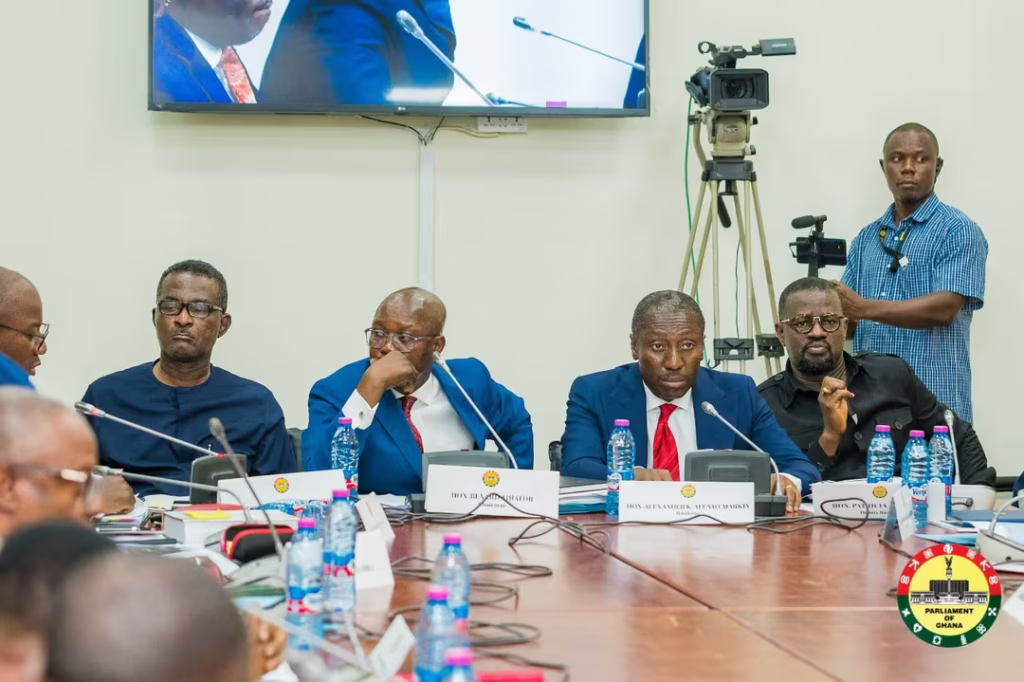
The opposition lawmakers had raised issues against the nomination and also the processes that led to the removal of Gertrude Torkornoo as Chief Justice.
“We vote to reject the nominee. The Majority can proceed with the questions; we do not intend to proceed with any question. We are, however, registering in the strongest terms that we reject the nomination, and the records should reflect that the report of this committee be a majority report,” their leader, Alexander Afenyo-Markin, said during the vetting process.
The Chair of the Committee, Bernard Ahiafor, said, “We thank you very much, we wish you well.”
There was a heated banter between Mahama Ayariga and Alexander Afenyo Markin, Majority and Minority leaders respectively, during the vetting of the Chief Justice nominee.
The Minority Leader, Alexander Afenyo-Markin, said that his side of the house has the right to describe Justice Paul Baffoe-Bonnie as the disputed Chief Justice nominee.
“We gather to vet the disputed nominee for the office of Chief Justice. This is a case of whether Ghana’s judiciary will remain independent,” he said during the vetting by the Appointments Committee of Parliament. He added, “It’s the Minority’s view to describe Justice Baffoe-Bonnie as the disputed Chief Justice.”
But in the view of Prof Asare, the walkout was not useful.
In a Facebook post, he said ,”The Minority Silenced Itself: Vetting is the constitutional forum for asking questions and demanding answers. By walking out, the Minority silenced itself. Answers cannot be obtained from outside the committee room.
“The Minority Lost Its Place in the Record: Parliamentary vetting is transcribed for history. Future generations will read who asked what and who stood for what. The Minority’s absence leaves only a blank space in the national record.”
Below is his full post…
Yesterday, the Minority boycotted the vetting of the CJ nominee. Boycotts, of course, can be powerful instruments of protest. They can awaken consciences, galvanize the public, and expose injustice.
Consider the Accra Boycott of 1948, organized by Nii Kwabena Bonne II to protest rising prices and to compel merchants to reduce prices.
That was a boycott with purpose — one that combined public participation, moral clarity, and strategic pressure.
But not all boycotts meet those standards. Some drain energy without yielding results, especially when they are used against functioning democratic processes that depend on participation, not withdrawal.
The Minority caucus’s boycott of the CJ’s vetting falls into that latter category. It neither altered the outcome nor advanced the cause of accountability.
Here are the Top Ten Reasons Why the Boycott Was Not Useful and What the Minority Missed by Doing So:
- The Minority Silenced Itself: Vetting is the constitutional forum for asking questions and demanding answers. By walking out, the Minority silenced itself. Answers cannot be obtained from outside the committee room.
- The Minority Lost Its Place in the Record: Parliamentary vetting is transcribed for history. Future generations will read who asked what and who stood for what. The Minority’s absence leaves only a blank space in the national record.
- The Minority Forfeited the Power of the Question: A single pointed question can reveal more than a week of press statements. By boycotting, the Minority surrendered that power and the chance to frame the moral and legal debate.
- The Minority Strengthened What It Opposed: The process did not stop because of their absence. It simply continued unchallenged. In politics, vacuums are quickly filled, usually by those one seeks to restrain.
- The Minority Lost the Moral High Ground: Engagement is harder but nobler than exit. The boycott appeared petulant rather than principled, forfeiting the moral authority that comes from constructive participation.
- The Minority Wasted a Constitutional Privilege: Few democratic tools are as potent as the power to question a nominee for the nation’s highest judicial office. That opportunity will not return soon, yet it was discarded.
- The Minority Undermined Oversight: Checks and balances work only when both sides show up. The Minority’s absence turned oversight into oversight failure.
- The Minority Ceded the Narrative: The vetting went on. The Majority asked the questions, the nominee answered, and the public heard one voice. The Minority’s perspective vanished from the airwaves and the record.
- The Minority Reduced Politics to Symbolism: Boycotts attract short-term headlines but leave no long-term impact. Substance resides in the debate transcript, not in the empty chair.
- The Minority Forgot Who Sent Them There: Voters elected the caucus to speak on their behalf, not to stay away. Constituents expect presence, diligence, and voice — not absence, neglect, and silence.
The GOGO Bottom Line
Boycotts can be noble when they resist oppression or demand justice. But when used to escape engagement in a legitimate constitutional process, they serve only as symbolic sulks.
The Chief Justice was still vetted. He excelled. He’d be confirmed, and sworn in. The Minority will still have to work with him.
Democracy thrives when leaders show up, speak up, and stand firm — not when they stay away.
Source: 3news.com By Laud Nartey