President John Dramani Mahama has urged Ghanaians to strive to stabilise the Cedi in its redenominated form.
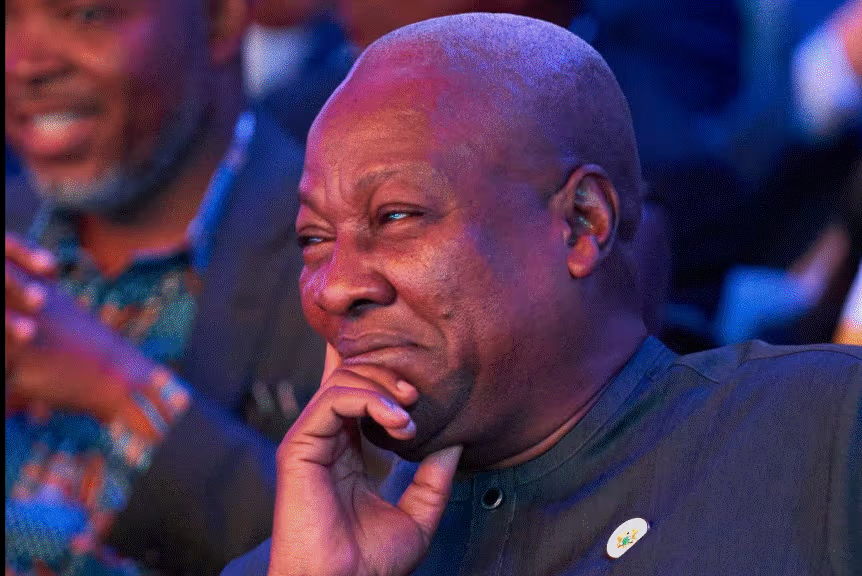
He noted that almost 20 years after that Cedi redomination by the Kufuor administration in 2007, people are still calculating the local currency in the old denomination.
Speaking during the Cedi at 60 International Currency Conference in Accra on Tuesday, November 18, he said “I think this current phase of the Cedi was introduced in President Kuffuor’s time, in 2007, if I am not mistaken. And so 2027 will be 20 years of the current redenomination of the Cedi, and yet it is very interesting that [people still calculate in old Cedi]. I was at a funeral, and somebody donated 100,000 Cedis and when it was announced that someone had given 100,000 Cedis, the whole place was quiet. But I thought the guy deserved a very big round of applause. Apparently, they didn’t understand what 100,000 Cedis was. So when the MC said it was One Billion Cedis, [they were excited]. I say 20 years on, we still are calculating in one billion Cedis instead of 100,000 Cedis. I think we must try and move on and call the Cedi for what it is.”
President Mahama used the occasion to extol the Bank of Ghana (BoG) for the way and manner the Cedi has been managed so far.
He urged the central bank to keep doing what it has done. He noted that owing to the good work by the BoG, the cedi has gained a lot of respect from Ghanaians lately.
“Ghanaians are grateful to you [Bank of Ghana] for the management of the cedi; a lot of respect has returned to our currency. Whatever you have been doing, continue doing so that the Cedi is respected,” he said during the Cedi at 60 International Currency Conference in Accra on Tuesday, November 18.
For his part, Governor of the Bank of Ghana (BoG) Dr Johnson Asiama, charged every Ghanaian and institution to endeavour to protect the local currency, the Cedi.
He makes the point that the protection of the Cedi is not the function of only one institution but a collective action.
“Protecting the Cedi is not the task of any one’s institution; it is a shared endeavouring, endeavouring that is rooted in our belief in Ghana’s future,” he also said during the Cedi at 60 International Currency Conference in Accra on Tuesday, November 18.
Dr Asiama earlier said that holding dollars in anticipation of a return to Cedi depreciation may not be a wise choice.
“We should all reaffirm our collective responsibility to protect the value and integrity of the currency. In addition to being a medium of exchange, the Cedi is a symbol of our pride, heritage and shared aspirations for a prosperous future,” Dr Asiama said in a statement read on his behalf at the 29th National Banking and Ethics Conference in Accra.
Dr Asiama further said that the Ghana cedi has appreciated cumulatively by 37.04% year-to-date (October 17, 2025), reversing the sharp 19.2% depreciation in 2024 – a powerful signal of improving fundamentals and policy credibility.
According to the World Bank, the cedi is the best-performing currency in Sub-Saharan Africa in the first eight months of 2025. Inflation has eased, driven by a tight monetary policy stance, exchange rate stability, and a broad moderation in price pressures.
The central question on everyone’s mind—and boldly captured in this year’s conference theme—is the sustainability of the cedi’s stability in the face of emerging financial disruptions.
“These gains reflect deliberate action by the Bank of Ghana, working collaboratively with Government to implement strategy initiatives anchored on restoring stability, rebuilding market confidence, and laying the foundations for sustained growth.
“We shall continue to sustain the gains through robust implementation of monetary policy, reserve management, the Gold-for-Reserve Programme and stable remittance flows,” he said.
He also said that while the stability of the cedi could be threatened by global dynamics, including a possible rebound in the US dollar or reduction in commodity prices, the domestic policy stance is strong enough to cushion such shifts.
“We have strengthened enforcement and monitoring efforts in foreign exchange market to ensure effective regulation, fair pricing, transparency and reduced incentive for speculative arbitrage,” he said.
Source: 3news.com By Laud Nartey