
Governor of the Bank of Ghana (BoG), Dr Johnson Asaima, has said that in recent times, the roles of central banks have shifted – central banks are no longer judged only by policies they set, but by the trust they sustain.
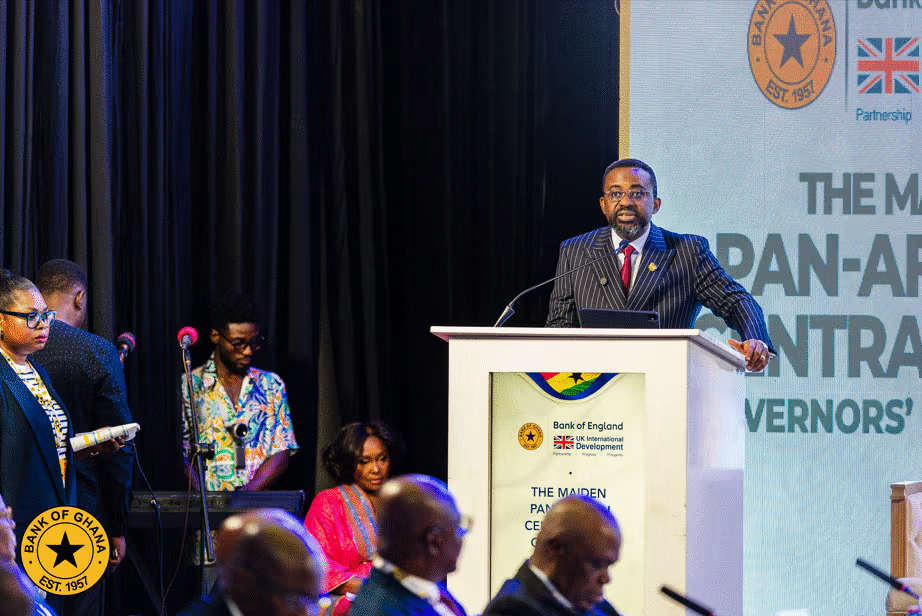
He made the point that leading a central bank has never been for the faint-hearted.
“We balance data with intuition, independence with coordination, and sometimes, optimism with insomnia. And if we’re honest, that balance comes at a price, the constant awareness that calm can turn to crisis in a heartbeat,” he said in his opening remarks during the Bank of Ghana/Bank of England Pan-African Central Bank Governors’ conference on Monday, November 10.
“And let me be honest, no one really tells you this before you become Governor: you never sleep the same again. You start checking your phone not for messages, but for markets. Even silence feels like a signal. Yet for all the sleepless nights, there is something extraordinary about this calling, the quiet knowledge that, in moments of uncertainty, the country still trusts us to steady the ship,” he added.
Dr Asiama explained that the responsibilities of central banks stretch across many dimensions of complexity. Sharing a few that test the limits of leadership, he cited the economic complexity as one of them.
“We are asked to deliver price stability, ensure financial soundness, and still support growth. We must translate models into judgment, and judgment into policy, all in real time, with imperfect data and impatient citizens. As one analyst once joked, ‘central bankers are expected to predict the future, and then be blamed for not changing it fast enough’.” he said.
The second issue he cited was the political economy – the daily test of judgment and courage.
He noted that they operate in the crossfire of expectations: governments seeking growth, politicians seeking results, businesses seeking credit, markets seeking signals, and the public seeking relief.
“Yet our duty is to defend the long-term horizon when everyone else is watching the next quarter. Balancing these competing interests without losing credibility is an art few appreciate until they sit in the chair,” he said.
Third, he said, the markets themselves. Volatility is now a constant companion – currencies, commodities, capital flows – all moving faster than policy can find the words to respond. One wrong signal, and sentiment can shift before sunrise, he said.
“We must act with speed, but never haste; and with prudence, but never paralysis,” he stressed.
The fourth issue he cited was the court of public opinion. “Every decision we make is now instantly debated, often before the official statement is even out. In a world of instant commentary, unpopular decisions, even when right, test not just our policies, but our composure. We must communicate with clarity, consistency, and humility, even when the message is uncomfortable.”
“And fifth, technology and global interconnectedness. We are facing unprecedented and unique pressures that demand a radical shift in operations, focus and capability; and we must adapt swiftly and boldly or risk losing relevance. The rapid adoption of technology, AI and digital payment systems is putting pressure on how the central bank ensures safety and control; and while the central mandate is not changing, the context in which we execute our mandate is evolving rapidly,” he said.
Dr Asiama said that all central banks face these challenges together, though in different languages, time zones, and fiscal positions.
“And that is why this meeting matters. Over the next two days, our aim is not to deliver lectures, but to exchange truths. These discussions are designed not for theory, but for candour and insight. We will reflect on effective governance, central bank independence, accountability, and the courage to make difficult decisions, not as theory, but as lived experience, shared candidly,” he said.
Earlier, Dr Asiama attended a gathering of regulators at Mansion House in the City of London, hosted by the Commonwealth Enterprise and Investment Council, where regulators and private sector players from across the world, as well as regulators, including the FCA, came together to exchange ideas openly.
He said what struck him most was not the agenda itself, but the spirit of collaboration: regulators learning from one another, testing assumptions, and listening with respect. It reminded me that our profession advances not only through policy, but through partnership.
Source: 3news.com By Laud Nartey