There seems to be no end in sight for the woes of the Ghana Railways Company Limited.
From years of inactivity, unpaid salaries, and deteriorating infrastructure, the company now faces perhaps its gravest threat yet: the complete takeover of one of its most profitable lines by illegal mining activities.
The Takoradi to Nsuta line was once the “mainstay” of the Ghana Railways Company. At its peak, the company hauled an average of 80,000 tonnes of manganese per month, a volume that not only sustained the company’s operations but also supported the Sekondi–Takoradi passenger train service.
However, years of neglect and poor maintenance led to frequent derailments, crippling the company’s ability to sustain its haulage operations. Even interventions by the Ghana Manganese Company and other stakeholders were unable to revive the line. By late 2024, haulage had ground to a halt, leaving the company in financial distress.
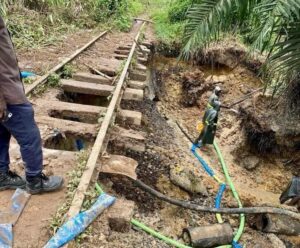
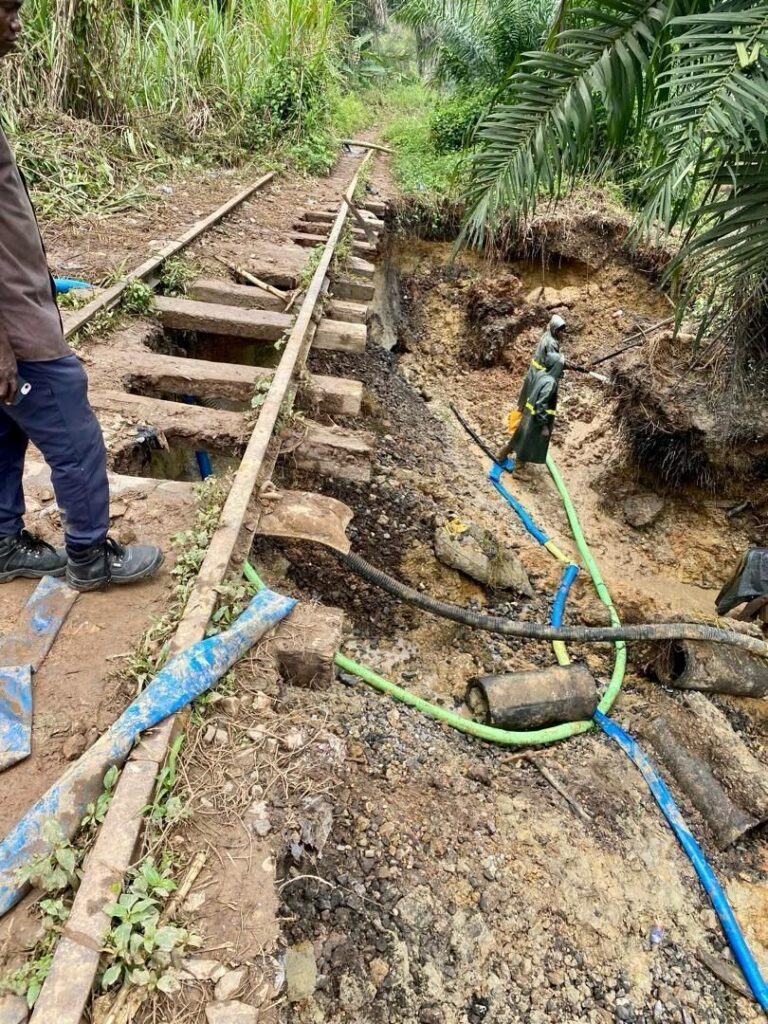
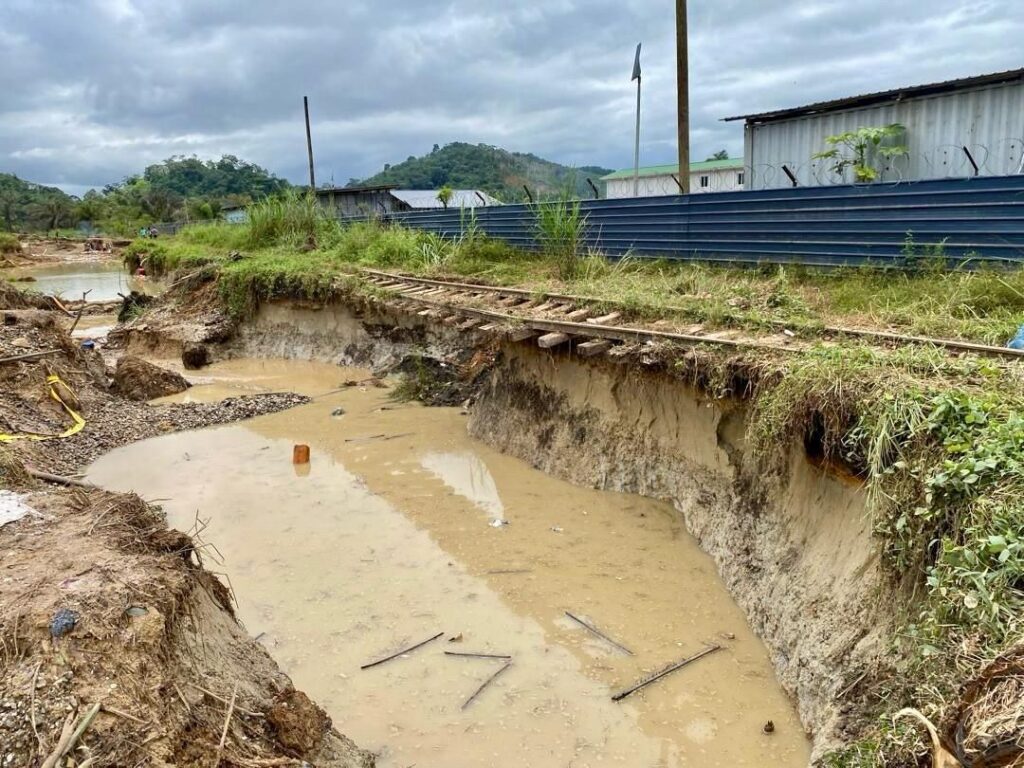
Now, the situation has worsened. Illegal small-scale miners, popularly known as galamseyers, have taken over sections of the Takoradi–Nsuta line. Pictures and videos obtained by ConnectNews show young men mining directly beneath and around the tracks at Achem between Bonsawire and Nsuta. Several metres of the line have already been destroyed.
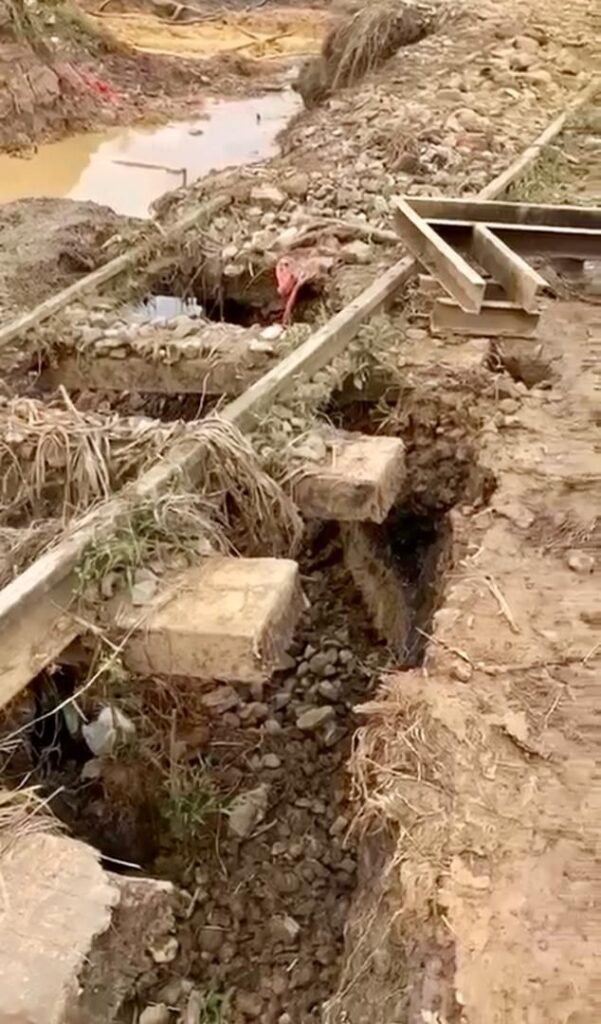
The activity of these illegal miners is brazen. The stench of freshly scooped earth and the humming of their machine fill the air. They appear unconcerned about the consequences of their actions on the lines and the environment. Alarmingly, the mining is taking place just behind one of the sites of Armandi Holdings, the contractor working on the new standard gauge railway. The extent of the damage suggests the activity has been ongoing for weeks, raising questions about how such destruction could occur so close to an active construction site without its being detected or any intervention.
Worse, the illegal mining is inching dangerously close to the new standard gauge lines—a multi-million-dollar project that the country is yet to benefit from. Rail lines have already been laid up to Manso, with land formation completed up to Esuaso before Bonsawire. The encroachment of galamsey threatens to derail this critical investment before it even becomes operational.
Checks by ConnectNews reveal that management of the Ghana Railways Company is aware of the situation but appears powerless to act. Workers, demoralized by 11 months of unpaid salaries, have abandoned routine patrols of the lines.
“We used to patrol the lines, but have since stopped. There is no motivation. We have not been paid for 11 months. I can confirm that management is aware of what is happening at Achem. These videos and pictures have been shared on our various WhatsApp groups,” one worker lamented to ConnectNews.
The decline of the Ghana Railways Company Limited is stark. In 2020, the company recorded one of its highest manganese haulages, moving 800,000 tonnes and generating a profit of “GH¢57.12 million.” However, from that year onwards, haulage became inconsistent and eventually ceased entirely in late 2024 due to the poor state of the tracks. “It is sad, but Railways is collapsing,” another worker admitted.
The destruction of the Takoradi–Nsuta line is part of a long thread of devastation caused by galamsey. Water bodies have become heavily silted, water treatment plants compromised or in some cases shut down, and power transmission lines threatened. Now, lines belonging to Ghana Railways Company Limited, which is already begging for attention, are under siege.
Despite numerous interventions by successive governments to fight galamsey, the menace persists, with new areas being discovered each day. They have rejected calls to declare a state of emergency, insisting it is not the solution. Yet, with each passing day, the cost of inaction grows.
The situation at Achem raises important questions. What must the country lose before a drastic action is taken? If galamsey can despoil land, poison foods, pollute water bodies, destroy a railway line, what can stop it from undermining bridges, dams, or other critical installations?
Frustration is gradually building up among scores of Ghanaians as the government fails to escalate its response. Among the drastic measures being proposed and gaining popularity, among the populace, considering the extent of the effects of galamsey, is a “shoot and kill” measure. Others fear such heavy-handed tactics could fuel tensions in mining communities, as already seen in some parts of the Ashanti Region.
The takeover of the Takoradi–Nsuta line by galamsey is more than a one-off incident, as it is a remnant of the struggle to protect national assets being affected by galamsey. The Ghana Railways Company, once a proud pillar of the nation’s industrial backbone, is on its knees and risks collapse.
As illegal miners dig away at the very foundations of the railway, the government is faced with two critical choices. Either galamsey is confronted with the urgency of a national emergency, or we watch as critical infrastructure, economic potential, and future development are buried under the rubble of inaction.
The question remains: what does the government wish to see happen before it finally sees it as worthy to declare galamsey as a national crisis?
Source: By Eric Adjei (3news.com)