The Government of Ghana has announced an expansive list of education initiatives in the 2026 Budget, outlining 21 interventions aimed at improving access, quality, and infrastructure across all levels of the education system.
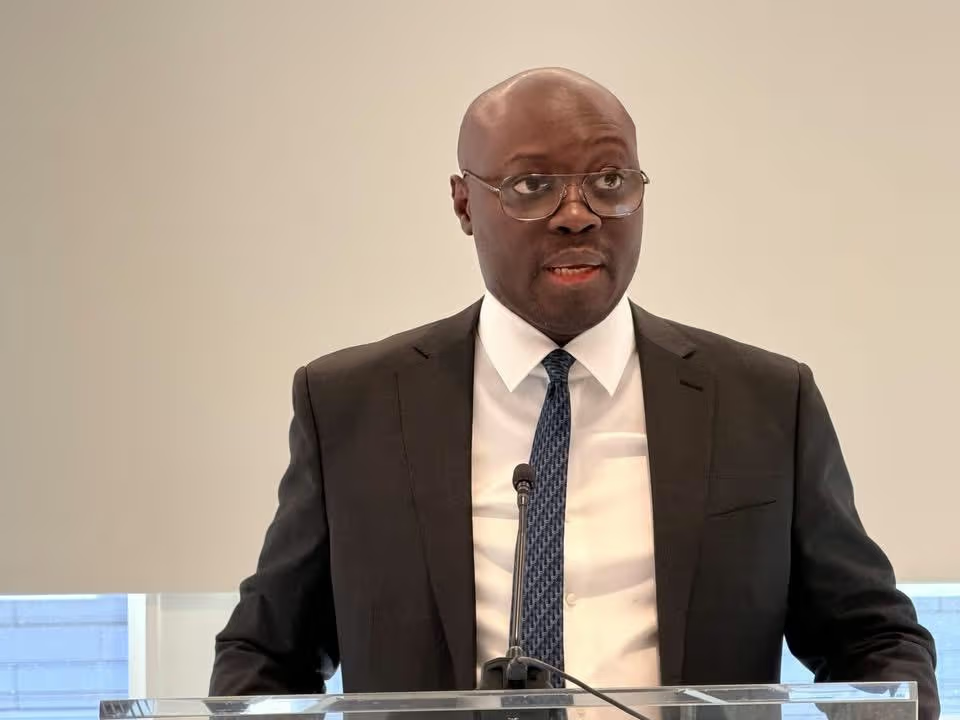
Speaking on the allocations, Daniel Fenyi, Head of Public Relations at the Ghana Education Service (GES), said the budget demonstrates the government’s renewed commitment to building a stronger and more equitable education sector.
“We have allocated GH₵33.3 billion to the Ministry of Education for all activities in 2026,” Fenyi said, describing it as one of the largest sector allocations in recent years.
He added that GH₵9.9 billion has been set aside for the Ghana Education Trust Fund (GETFund) to support infrastructural expansion and educational resources nationwide.
According to him, the implementation of the Free Secondary Education policy remains a priority, with GH₵4.2 billion earmarked for its continuation next year.
“To permanently end the double-track system and improve the quality of secondary education, we have allocated GH₵1.1 billion under the Ghana Secondary Learning Improvement Programme (GSLIP),” he stated.
Major Infrastructure Drive
Fenyi announced that GH₵2.0 billion has been allocated for extensive new school infrastructure.
“This includes the construction of 200 new Junior High Schools, 200 primary schools, 200 kindergartens, 400 teachers’ bungalows, and 400 sanitation facilities in underserved communities,” he explained.
In addition, GH₵3.0 billion will be used to provide key teaching and learning materials.
“We are procuring textbooks for learners from KG to JHS, over two million metal mono-desks and chairs, as well as 200 sixty-six-seater buses and 200 double-cabin pickups for secondary schools,” he said.
Social & Academic Support Interventions
The government is also scaling up social interventions to widen access and retention in schools.
“We have allocated GH₵25 million for Free Tertiary Education for Persons with Disabilities,” he revealed.
The No-Fee-Stress registration policy will continue in 2026 with GH₵537 million, alongside GH₵207 million for teacher trainee allowances and GH₵169 million for BECE registration fees.
Fenyi further noted that the government is committing GH₵292 million to provide free sanitary pads for girls, and GH₵1.98 billion to strengthen the School Feeding Programme.
“To enhance learning outcomes at the basic level, we have also allocated GH₵157 million for the Capitation Grant,” he added.
He confirmed that President John Mahama has directed all schools “to purchase only Ghana-produced rice, maize, chicken and eggs,” a move intended to boost local agriculture while supporting school nutrition.
Upgrading Schools & Reviving Abandoned Projects
As part of efforts to upgrade learning environments, 10 Category B schools will be elevated to Category A status and 30 Category C schools upgraded to Category B, all benefiting from modern classrooms, science laboratories, libraries, ICT facilities, and improved dormitories and WASH systems.
Fenyi also announced that the government will complete 30 abandoned E-Blocks to expand access to secondary education in urban and peri-urban areas.
Expansion of Tertiary Education
The tertiary sector will see major developments, including a new Science and Technology University in Damongo, funded by a $60 million facility.
“The University of Engineering and Agricultural Sciences at Bunso will open in 2026,” Fenyi confirmed, adding that construction of new Technical Universities in Jasikan and Techiman will also be completed.
The government will additionally establish two new public universities in Kintampo and Dambai to expand tertiary opportunities.
Fenyi emphasized that the 2026 Budget “lays the foundation for transformational change” across Ghana’s education sector, driven by investment in infrastructure, inclusion, and academic excellence.
Source: 3news.com